C.S. Lewis
A Belfast-born literature don at Oxford and Cambridge who wrote the seven Chronicles of Narnia, a science-fiction trilogy and the wartime radio talks that became Mere Christianity.
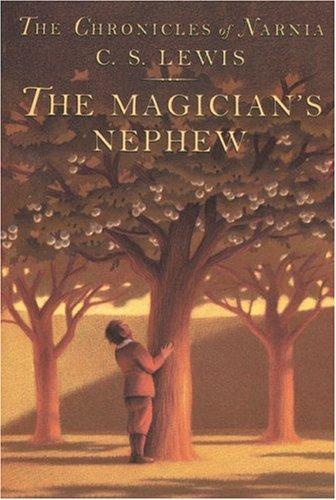
The Magician's Nephew
Published in 1955 as the sixth Narnia book, it comes first in the story's own chronology and is a prequel to The Lion, the Witch and the Wardrobe.21016 Greta Gerwig's film of it opens in theaters on Feb. 12, 2027.16
Bookshop.org (which supports independent bookstores) and Amazon links are affiliate links: we may earn a small commission on purchases, at no cost to you. As an Amazon Associate we earn from qualifying purchases. WorldCat links find the book in a library near you.
At a glance
- Born
- Clive Staples Lewis, Nov. 29, 1898, in Belfast; his father was a solicitor1
- Known as
- "Jack" to family and friends; his first two books of poems appeared as Clive Hamilton1
- Education
- University College, Oxford, with firsts in Honour Moderations, Greats and English14
- First World War
- Officer in the Somerset Light Infantry; wounded in 191813
- Posts
- Fellow and Tutor, Magdalen College, Oxford, 1925–1954; first Professor of Medieval and Renaissance English at Cambridge, 1954–19634
- Married
- Joy Davidman, an American poet, in 1956; she died in 196013
- Died
- Nov. 22, 1963, at The Kilns, his Oxford home13
- Major awards
- Carnegie Medal, 1956, for The Last Battle8
C.S. Lewis's Backstory
Early life
Clive Staples Lewis was born in Belfast on Nov. 29, 1898, the younger son of Albert Lewis, a solicitor, and Flora Hamilton Lewis; his elder brother was Warren, called “Warnie.”1 His mother died of cancer in 1908, and he was sent to schools in England, including Malvern College, before being tutored privately by William T. Kirkpatrick, whom he called “The Great Knock.”13
War and Oxford
He won a scholarship to University College, Oxford, in 1916, then served as an officer in the Somerset Light Infantry and was wounded in France in 1918.13 He had promised his friend Paddy Moore, who was killed in the war, that he would look after Moore’s mother, and he lived with her for many years.1 Back at Oxford he took firsts in Honour Moderations, Greats and English, and in 1925 he was elected Fellow and Tutor in English at Magdalen College, where he taught until 1954.16 His first two books, the poems Spirits in Bondage (1919) and Dymer (1926), appeared under the name Clive Hamilton.13
Conversion and the Inklings
Lewis had given up Christianity as a schoolboy.3 He came to believe in God in 1929, calling himself “the most dejected and reluctant convert in all England,” and after long talks with J.R.R. Tolkien and Hugo Dyson he returned to Christianity in 1931.1 With Tolkien, Charles Williams, Owen Barfield and others he belonged to the Inklings, a group that met at the Eagle and Child pub in Oxford.1 His science-fiction trilogy began with Out of the Silent Planet (1938), and The Screwtape Letters followed in 1942.23 Between 1941 and 1944 he gave 25 BBC radio talks, later developed into Mere Christianity (1952).3
Narnia
The Lion, the Witch and the Wardrobe was published in London on Oct. 16, 1950, with illustrations by Pauline Baynes.7 Lewis said the story began with a picture he had carried since about age 16, a faun with an umbrella and parcels in a snowy wood.14 He had no plan for a series when he wrote it; six more books followed, one a year, ending with The Last Battle (1956), which won the Carnegie Medal.1128 Geoffrey Bles published the first five and The Bodley Head the last two; HarperCollins is now the series’ worldwide publisher.7 Lewis described the books as “supposals” rather than allegory.1112
Cambridge, marriage and last years
In 1954 Lewis became the first Professor of Medieval and Renaissance English at Cambridge, with a fellowship at Magdalene College.45 He married the American poet Joy Davidman in a civil ceremony in 1956 and in a church ceremony at her hospital bed in 1957; she died of cancer in 1960.31 He wrote about his grief in A Grief Observed (1961), published as N.W. Clerk.1 He resigned his Cambridge chair in 1963 after learning he was terminally ill, and he died at The Kilns, his home in Oxford, on Nov. 22, 1963.513 In 2013, 50 years after his death, a memorial stone was placed in Poets’ Corner at Westminster Abbey.15
Fun facts
- "Jack" came from the family dog, Jacksie; after the dog was killed, four-year-old Lewis announced that Jacksie was now his own name.1
- Narnia began with a picture he had carried in his head since about age 16: a faun with an umbrella and parcels in a snowy wood.14
- When he wrote The Lion, the Witch and the Wardrobe he had no plan for a series; the other six books grew out of it.11
- Writing for children, he said, made him limit his vocabulary and make the chapters nearly equal in length for reading aloud.11
- He published A Grief Observed, his account of mourning his wife, under the pseudonym N.W. Clerk.13
- He died on Nov. 22, 1963, the same day President John F. Kennedy was assassinated and Aldous Huxley died.1
Books
In order of first publication. Each series is kept together, in reading order, starting where its first book appeared. Titles and first-publication years from Dallas Baptist University's C.S. Lewis bibliography, checked against Christianity Today's Christian History timeline; letters, the diary, the wartime broadcast pamphlets later gathered into Mere Christianity and the Aeneid translation are left out.23
Bookshop.org (which supports independent bookstores) and Amazon links are affiliate links: we may earn a small commission on purchases, at no cost to you. As an Amazon Associate we earn from qualifying purchases. WorldCat links find the book in a library near you.
- 1919
- 1926
- 1933The Pilgrim's Regress
- 1936The Allegory of Love
The Space Trilogy
- 1938Book 1Out of the Silent Planet
- 1943Book 2Perelandra
- 1945Book 3That Hideous Strength
- 1938
- 1939Rehabilitations and Other Essays
- 1939The Personal Heresy
- 1940The Problem of Pain
- 1942A Preface to "Paradise Lost"
- 1942
- 1943The Abolition of Man
- 1945The Great Divorce
- 1946George MacDonald: An Anthology
- 1947Essays Presented to Charles Williams
- 1947Miracles
- 1948Arthurian Torso
- 1949Transposition and Other Addresses
The Chronicles of Narnia
Numbered here in publication order. Since 1994 HarperCollins has numbered them in story order, starting with The Magician's Nephew; Lewis told a young reader in 1957 the order "does not matter very much."710
- 1950
- 1951Book 2Prince Caspian
- 1952Book 3The Voyage of the "Dawn Treader"
- 1953Book 4The Silver Chair
- 1954Book 5The Horse and His Boy
- 1955
- 1956
- 1952
- 1954English Literature in the Sixteenth Century, Excluding Drama
- 1955Surprised by Joy
- 1956Till We Have Faces
- 1958Reflections on the Psalms
- 1960Studies in Words
- 1960The Four Loves
- 1960The World's Last Night and Other Essays
- 1961
- 1961An Experiment in Criticism
- 1961Screwtape Proposes a Toast
- 1962They Asked for a Paper
- 1964
- 1964
- 1964
- 1966Of Other Worlds
- 1966Studies in Medieval and Renaissance Literature
- 1967Christian Reflections
- 1967Spenser's Images of Life
- 1969Narrative Poems
- 1969Selected Literary Essays
- 1970God in the Dock
- 1975Fern-Seed and Elephants
- 1977The Dark Tower and Other Stories
- 1980The Weight of Glory and Other Addresses
- 1986
- 1986Present Concerns
- 2013Image and Imagination
- 2015The Collected Poems of C.S. Lewis
Latest news
Adaptations and other media
Film
- The Chronicles of Narnia: The Lion, the Witch and the Wardrobe2005Based on The Lion, the Witch and the Wardrobe
A Walden Media and Walt Disney Pictures film directed by Andrew Adamson.9
- The Chronicles of Narnia: Prince Caspian2008Based on Prince Caspian
A Disney and Walden Media film.9
- The Chronicles of Narnia: The Voyage of the Dawn Treader2010Based on The Voyage of the "Dawn Treader"
A Fox 2000 Pictures and Walden Media film, distributed by 20th Century Fox.9
- Narnia: The Magician's NephewAnnounced for 2027Based on The Magician's Nephew
Written and directed by Greta Gerwig for Netflix, with Carey Mulligan, Daniel Craig, Meryl Streep and Emma Mackey; in theaters Feb. 12, 2027, and on Netflix April 2, 2027.16
Television
- The Lion, the Witch and the Wardrobe1967Based on The Lion, the Witch and the Wardrobe
A ten-part serial directed by Helen Standage and written by Trevor Preston; only two episodes survive.9
- The Lion, the Witch and the Wardrobe1979Based on The Lion, the Witch and the Wardrobe
An animated special co-produced by Bill Melendez and the Children's Television Workshop; it won an Emmy for Outstanding Animated Program.9
- The Chronicles of Narnia (BBC)1988–1990Based on The Lion, the Witch and the Wardrobe, Prince Caspian, The Voyage of the "Dawn Treader" and The Silver Chair
Three BBC serials based on the first four books, shown in the U.S. on PBS's WonderWorks.9
Stage
- The Lion, the Witch and the Wardrobe1998Based on The Lion, the Witch and the Wardrobe
A Royal Shakespeare Company production adapted by Adrian Mitchell, with music by Shaun Davey.9
Audio and radio
- Tales of Narnia1988–1997
A BBC Radio 4 full-cast dramatization of about 15 hours, with Maurice Denham as Professor Kirke.9
- The Chronicles of Narnia (Radio Theatre)1999–2002Based on The Lion, the Witch and the Wardrobe, Prince Caspian, The Voyage of the "Dawn Treader", The Silver Chair, The Horse and His Boy, The Magician's Nephew and The Last Battle
Focus on the Family's radio dramatizations of all seven books, with Paul Scofield as the Storyteller and David Suchet as Aslan.9
Video and tabletop games
- The Chronicles of Narnia: The Lion, the Witch and the Wardrobe2005Based on The Lion, the Witch and the Wardrobe
A video game published by Buena Vista Games, developed by Traveller's Tales for consoles and PC and by Amaze Entertainment for Nintendo handhelds.9
Myth and record
The claimLewis wrote "You don't have a soul. You are a soul. You have a body," a line often attributed to him.13
The recordThe C.S. Lewis Foundation lists it among quotes Lewis did not write and calls it a paraphrase of a passage in George MacDonald's Annals of a Quiet Neighbourhood.13
The claimThe Chronicles of Narnia are an allegory, with Aslan standing for Christ.12
The recordLewis rejected the label: in a 1958 letter he said Aslan was "not allegory at all" but a "supposal," and in 1962 he wrote that the books were "not as much allegory as supposal."1211
Timeline
Born in Belfast.1
His mother, Flora, dies of cancer.3
Wounded in action in France and sent to hospital in London.3
Publishes his first book, the poems Spirits in Bondage, as Clive Hamilton.3
Elected Fellow and Tutor in English at Magdalen College, Oxford.6
Returns to Christianity after talks with J.R.R. Tolkien and Hugo Dyson.13
Gives 25 BBC radio talks, later developed into Mere Christianity.3
The Lion, the Witch and the Wardrobe is published in London.7
Becomes the first Professor of Medieval and Renaissance English at Cambridge.45
Marries Joy Davidman; The Last Battle wins the Carnegie Medal.38
A memorial stone is placed in Poets' Corner, Westminster Abbey, 50 years after his death.15
Gerwig's Narnia: The Magician's Nephew is set for Feb. 12, 2027.16
What came after
Narnia: The Magician's Nephew, written and directed by Greta Gerwig, opens in IMAX sneak previews on Feb. 10, 2027, in theaters on Feb. 12 and on Netflix on April 2.16
Sources
- C.S. Lewis New World EncyclopediaReference
- C. S. Lewis Bibliography Dallas Baptist University (Philip Irving Mitchell)Reference
- C.S. Lewis Christian History Timeline Christianity Today (Christian History)Reference
- Lewis, C.S. (1898-1963), writer and Fellow of Magdalene College, Cambridge Magdalene College Archives, CambridgeArchival record
- C.S. Lewis: 50 years after his death, a new scholarship will honour his literary career University of CambridgePrimary record
- C. S. Lewis at Magdalen College Magdalen College, OxfordPrimary record
- The Chronicles of Narnia Wikipedia (IPFS mirror)Reference
- The Last Battle Wikipedia (IPFS mirror)Reference
- Adaptations of The Chronicles of Narnia WikipediaReference
- What Is the Correct Reading Order for The Chronicles of Narnia? Crosswalk.com (Cap Stewart)Website
- A Letter from C. S. Lewis The Horn BookPrimary record
- Why Narnia Isn't Allegorical The Gospel Coalition (Jared C. Wilson)Website
- Quotes Misattributed to C.S. Lewis C.S. Lewis FoundationWebsite
- Seventy-Five Years of Narnia Plough (Michael Ward)News
- Memorial stone for CS Lewis in Westminster Abbey RNZNews
- Greta Gerwig's 'Narnia' Moves to 2027 With Global Theatrical Release Before Netflix Debut Variety AustraliaNews