Kurt Vonnegut
An Indianapolis-born writer who survived the firebombing of Dresden as a prisoner of war and turned it, 24 years later, into Slaughterhouse-Five.
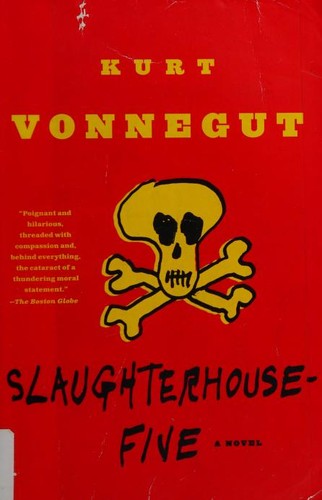
Slaughterhouse-Five, or The Children's Crusade: A Duty-Dance with Death
His 1969 novel about Billy Pilgrim, who comes "unstuck in time" while surviving the Dresden firebombing as a prisoner of war; it became his first bestseller.133
Bookshop.org (which supports independent bookstores) and Amazon links are affiliate links: we may earn a small commission on purchases, at no cost to you. As an Amazon Associate we earn from qualifying purchases. WorldCat links find the book in a library near you.
At a glance
- Born
- November 11, 1922, in Indianapolis, Indiana3
- Family
- The youngest of three children of architect Kurt Vonnegut Sr. and Edith Lieber, from a brewing family15
- Education
- Shortridge High School; Cornell University; anthropology at the University of Chicago31
- War service
- U.S. Army, 106th Infantry Division; captured at the Battle of the Bulge in December 194414
- Married
- Jane Marie Cox in 1945; photographer Jill Krementz in 197913
- Died
- April 11, 2007, in Manhattan, from brain injuries suffered in a fall at his home13
Kurt Vonnegut's Backstory
Early life
Kurt Vonnegut was born on November 11, 1922, in Indianapolis, the youngest of three children of the architect Kurt Vonnegut Sr. and Edith Lieber, whose family owned the Indianapolis Brewing Company.15 The Depression ended the family’s comfortable life.5 At Shortridge High School he worked on the student newspaper and became its editor in his senior year.5 He went on to Cornell University and left in 1943.31
Dresden
He enlisted in the U.S. Army and went to Europe with the 106th Infantry Division as an intelligence scout.1 In May 1944, while he was home on leave, his mother died of an overdose of sleeping pills.14 He was captured on December 22, 1944, during the Battle of the Bulge and held as a prisoner of war in Dresden.1 He survived the Allied firebombing of the city in February 1945 by sheltering in an underground meat locker, and was freed in May 1945.13
Chicago, Schenectady and Cape Cod
He married Jane Marie Cox in 1945 and studied anthropology at the University of Chicago while working as a reporter for the City News Bureau.14 He then worked in public relations for General Electric in Schenectady, New York, which gave him material for Player Piano and Cat’s Cradle.4 His first published story appeared in Collier’s in 1950, and in 1951 he quit GE to write full time and moved to Cape Cod.31 After his sister Alice and her husband died in 1958, the Vonneguts took in three of their sons.14
The novels
Player Piano, his first novel, appeared in 1952 and sold poorly at first; The Sirens of Titan (1959) and Cat’s Cradle (1963) were both nominated for the Hugo Award.1 After nearly two years teaching at the Iowa Writers’ Workshop he won a Guggenheim Fellowship in 1967.1 Slaughterhouse-Five (1969), which takes its title from the building in Dresden where he was held, reached the top of the New York Times best-seller list and made him famous.31 Breakfast of Champions (1973) was another bestseller, and he wrote fourteen novels in all.3
Later years
He married the photographer Jill Krementz in 1979.13 He wrote about his depression in Fates Worse Than Death (1991), and late in life he turned largely to visual art, working with the Kentucky artist Joe Petro III.4 A Man Without a Country (2005) was his last book published in his lifetime.1 He died in Manhattan on April 11, 2007, of brain injuries from a fall at his home weeks earlier.1 He was inducted into the Science Fiction and Fantasy Hall of Fame in 2015.3
Fun facts
- The University of Chicago accepted Cat's Cradle in place of the master's thesis he never finished, 25 years after he left.13
- In 1957 he ran a Saab dealership on Cape Cod, and it failed.14
- As a prisoner in Dresden he worked in a factory making a vitamin-fortified malt syrup for pregnant women.4
- After the firebombing, he and other prisoners were put to work digging bodies out of the rubble.1
- He played clarinet in his high school jazz band and edited the Shortridge student newspaper.35
- The asteroid 25399 Vonnegut is named for him.1
- At 82 he appeared on The Daily Show to promote A Man Without a Country.4
- He praised the 1972 film of Slaughterhouse-Five, writing that George Roy Hill and Universal had made "a flawless translation" of his novel.10
Books
In order of first publication. Each series is kept together, in reading order, starting where its first book appeared. Novels, story collections, essay collections and posthumous books from Wikipedia's Kurt Vonnegut bibliography, dated by first publication; his short plays and the Library of America collected editions are left out.2
Bookshop.org (which supports independent bookstores) and Amazon links are affiliate links: we may earn a small commission on purchases, at no cost to you. As an Amazon Associate we earn from qualifying purchases. WorldCat links find the book in a library near you.
- 1952
- 1959
- 1961Canary in a Cathouse
- 1961Mother Night
- 1963
- 1965God Bless You, Mr. Rosewater, or Pearls Before Swine
- 1968Welcome to the Monkey House
- 1969
- 1973
- 1974Wampeters, Foma and Granfalloons (Opinions)
- 1976Slapstick, or Lonesome No More!
- 1979Jailbird
- 1981Palm Sunday: An Autobiographical Collage
- 1982Deadeye Dick
- 1984Nothing Is Lost Save Honor: Two Essays
- 1985Galápagos
- 1987Bluebeard, the Autobiography of Rabo Karabekian (1916–1988)
- 1990Hocus Pocus
- 1991Fates Worse Than Death: An Autobiographical Collage
He wrote openly about depression in it.4
- 1997
- 1999Bagombo Snuff Box
- 2005A Man Without a Country
His last book published in his lifetime, and a bestseller.1
- 2008Armageddon in Retrospect
Published after his death; stories, letters and essays on war and peace.2
- 2009Look at the Birdie: Unpublished Short Fiction
Published after his death.2
- 2011While Mortals Sleep: Unpublished Short Fiction
Published after his death.2
- 2012Kurt Vonnegut: The Cornell Sun Years 1941–1943
His student journalism, published after his death.2
- 2012We Are What We Pretend to Be: The First and Last Works
Published after his death.2
- 2013If This Isn't Nice, What Is?: Advice to the Young
His commencement speeches, published after his death.2
- 2013Sucker's Portfolio: A Collection of Previously Unpublished Writing
Published after his death.2
Latest news
The Kurt Vonnegut Museum & Library held its Night of Vonnegut gala at the Indianapolis Central Library, giving its 2026 Kurt Vonnegut Humor Award to The Daily Show host Jordan Klepper.7
With help from Penguin Random House's Intellectual Freedom Taskforce, the Vonnegut estate joined an ACLU of Utah lawsuit over a Utah book-ban law; Slaughterhouse-Five is at the center of the case, and his daughter Nanette Vonnegut has spoken about it on NPR.9
Adaptations and other media
Film
- Happy Birthday, Wanda June1971
A film directed by Mark Robson from Vonnegut's 1970 play.11
- Slaughterhouse-Five1972Based on Slaughterhouse-Five, or The Children's Crusade: A Duty-Dance with Death
A Universal film directed by George Roy Hill, with Michael Sacks as Billy Pilgrim and Valerie Perrine as Montana Wildhack.1011
- Who Am I This Time?1982
Jonathan Demme's adaptation of the 1961 short story, with Christopher Walken.11
- Mother Night1996Based on Mother Night
A film directed by Keith Gordon, with Nick Nolte.11
- Breakfast of Champions1999Based on Breakfast of Champions, or Goodbye Blue Monday
A film directed by Alan Rudolph, with Bruce Willis; Collider calls it "incredibly unsuccessful."1112
Myth and record
The claimVonnegut gave a 1997 MIT commencement address that begins with the advice to "wear sunscreen," a text that spread widely by email under his name.6
The recordThe text was a satirical Chicago Tribune column by Mary Schmich, published June 1, 1997; MIT's speaker that year was U.N. Secretary-General Kofi Annan, and Vonnegut told Schmich the piece was witty but "it wasn't my wittiness."6
Timeline
Born in Indianapolis.3
Graduates from Shortridge High School and enrolls at Cornell.4
Captured during the Battle of the Bulge.1
Survives the Allied firebombing of Dresden in an underground meat locker.13
Leaves his public-relations job at General Electric to write full time.31
His first novel, Player Piano, is published.3
Slaughterhouse-Five is published and reaches the top of the New York Times best-seller list.1
A Man Without a Country, his last book in his lifetime, becomes a bestseller.1
Dies in Manhattan, weeks after a fall at his home.1
Inducted into the Science Fiction and Fantasy Hall of Fame.31
The Kurt Vonnegut Museum & Library holds its 2026 Night of Vonnegut gala.7
What came after
The Kurt Vonnegut Museum & Library in Indianapolis, which the American Library Association named Indiana's first Literary Landmark, runs writing programs, exhibitions and events in his name.78
Sources
- Kurt Vonnegut WikipediaReference
- Kurt Vonnegut bibliography Wikipedia (IPFS mirror)Reference
- Kurt Vonnegut Biography.comReference
- Vonnegut's Life College of CharlestonWebsite
- Kurt Vonnegut Encyclopedia of IndianapolisReference
- Commencement speech attributed to Vonnegut is a hoax MIT NewsPrimary record
- Night of Vonnegut 2026 Gala Kurt Vonnegut Museum & LibraryPrimary record
- Vonnegut Museum Becoming Literary Landmark Inside Indiana BusinessNews
- Kurt Vonnegut's daughter defends her father's work against the state of Utah Penguin Random HousePrimary record
- How Kurt Vonnegut Really Felt About The Slaughterhouse-Five Movie Adaptation /FilmNews
- The 6 best films based on works by Kurt Vonnegut Jr. Far Out MagazineNews
- Kurt Vonnegut adaptations ColliderNews
- Slaughterhouse-Five: A Novel Bookshop.org (Dial Press listing)Website