Maya Angelou
A singer, dancer and civil rights organizer who turned to writing in her forties; her seven autobiographies began with *I Know Why the Caged Bird Sings* in 1969.
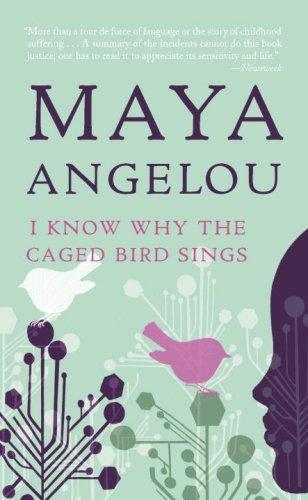
I Know Why the Caged Bird Sings
The first of her seven autobiographies, covering her childhood in Stamps, Arkansas, St. Louis and California.14
Bookshop.org (which supports independent bookstores) and Amazon links are affiliate links: we may earn a small commission on purchases, at no cost to you. As an Amazon Associate we earn from qualifying purchases. WorldCat links find the book in a library near you.
At a glance
- Born
- Marguerite Annie Johnson, April 4, 1928, in St. Louis, Missouri3
- Raised
- In Stamps, Arkansas, largely by her paternal grandmother, Annie Henderson32
- Her name
- "Maya" came from her brother's name for her; "Angelou" from a version of her first husband's surname32
- Before writing
- Streetcar conductor, calypso singer and dancer, actor, journalist in Egypt and Ghana, and civil rights organizer29
- Honors
- National Medal of Arts (2000); Presidential Medal of Freedom (2011); three Grammy Awards for spoken-word albums1114
- Died
- May 28, 2014, at her home in Winston-Salem, North Carolina, aged 8616
- Major awards
- Literarian Award for Outstanding Service to the American Literary Community (National Book Foundation), 201310
Maya Angelou's Backstory
Early life
Maya Angelou was born Marguerite Annie Johnson in St. Louis, Missouri, on April 4, 1928.3 When she was three, her parents’ marriage ended and she and her brother, Bailey, were sent to Stamps, Arkansas, to live with their paternal grandmother, Annie Henderson, who ran a store there.3 It was Bailey who began calling her “Maya.”3 In I Know Why the Caged Bird Sings she described being raped by her mother’s boyfriend at the age of seven; she stopped speaking for years afterward, and, as the Smithsonian notes, spent that time reading and memorizing poetry.122
Many careers
As a teenager in San Francisco she studied dance and drama at the California Labor School and, in 1943, became the city’s first Black streetcar conductor.269 She sang calypso and danced at the Purple Onion nightclub, where she adopted the name Maya Angelou, toured Europe and Africa in Porgy and Bess in 1954 and 1955, and recorded Miss Calypso in 1957.26 In New York she joined the Harlem Writers Guild, and in 1960 Martin Luther King Jr. recruited her as northern coordinator of the Southern Christian Leadership Conference.82
Africa and the civil rights movement
She edited the Arab Observer in Cairo, then moved to Ghana in 1963, where she wrote for the Ghanaian Times and met Malcolm X.225 She returned to the United States in 1964 to help him build the Organization of Afro-American Unity; he was assassinated soon after.26 King was killed on her 40th birthday in 1968.26
The autobiographies
I Know Why the Caged Bird Sings, published in 1969, was the first of seven autobiographies that carried her story from Arkansas to Africa and back, ending with Mom & Me & Mom in 2013.113 Her first book of poems, Just Give Me a Cool Drink of Water ‘fore I Diiie (1971), was nominated for the Pulitzer Prize.14 She went on to publish more poetry, books of essays, children’s books and two cookbooks.13
Later years
In 1993 she read “On the Pulse of Morning” at Bill Clinton’s inauguration, which brought her wide fame.5 She received the National Medal of Arts in 2000, the Presidential Medal of Freedom in 2011 and the National Book Foundation’s Literarian Award in 2013, and won three Grammy Awards for spoken-word recordings.111014 She died at her home in Winston-Salem, North Carolina, on May 28, 2014, aged 86.16 In 2022 she became the first Black woman to appear on a U.S. coin.18
Fun facts
- "Maya" began as her older brother Bailey's version of "my sister."3
- In 1957 she released an album of calypso songs, Miss Calypso.6
- Before he became famous, Alvin Ailey danced with her as the duo "Al and Rita."25
- She worked as editor of the Arab Observer, a weekly newspaper in Cairo.2
- Martin Luther King Jr. was assassinated on her 40th birthday, April 4, 1968.26
- She wrote the poetry for the 1993 film Poetic Justice and played Aunt June in it.1
- She made her debut as a film director with Down in the Delta (1998).12
- In 2020 the San Francisco Arts Commission approved a sculpture honoring her, citing her role as the city's first Black woman streetcar conductor.7
Books
In order of first publication. Each series is kept together, in reading order, starting where its first book appeared. Titles and years from Wikipedia's list of Maya Angelou's works; collected and omnibus editions are left out.13
Bookshop.org (which supports independent bookstores) and Amazon links are affiliate links: we may earn a small commission on purchases, at no cost to you. As an Amazon Associate we earn from qualifying purchases. WorldCat links find the book in a library near you.
- 1969
- 1974
- 1976
- 1981
- 1986
- 2002Book 6A Song Flung Up to Heaven
- 2013
- 1971
- 1975
- 1978
- 1983Shaker, Why Don't You Sing?
- 1986Mrs. Flowers: A Moment of Friendship
- 1987Now Sheba Sings the Song
- 1990
- 1993
- 1993On the Pulse of Morning
The poem she read at Bill Clinton's 1993 inauguration.5
- 1993
- 1994
- 1995A Brave and Startling Truth
- 1995Phenomenal Woman: Four Poems Celebrating Women
- 1996
- 1997Even the Stars Look Lonesome
- 2004Hallelujah! The Welcome Table: A Lifetime of Memories with Recipes
Maya's World
Four picture books published together in 2004.13
- 2004Angelina of Italy
- 2004Izak of Lapland
- 2004Mikale of Hawaii
- 2004Renée Marie of France
- 2004
- 2005
- 2006Mother: A Cradle to Hold Me
- 2008
- 2010Great Food, All Day Long: Cook Splendidly, Eat Smart
Latest news
Her estate joined a lawsuit, first filed by the ACLU for Kurt Vonnegut's estate, challenging Utah's Sensitive Materials Law, after two Utah school districts banned I Know Why the Caged Bird Sings.20
Myth and record
The claimAngelou said, "People will forget what you said, people will forget what you did, but people will never forget how you made them feel"; the line is widely quoted under her name.24
The recordQuote Investigator's earliest evidence for the saying is a 1971 quotation book that credits it to Carl W. Buehner, a Latter-day Saints church official, long before it was linked with Angelou.23 The record does not show where the version credited to her first appeared.
The claimShe wrote "A bird doesn't sing because it has an answer, it sings because it has a song," the line printed beside her portrait on the 2015 U.S. Postal Service Forever stamp.22
The recordAfter the stamp was unveiled, the Emerson College professor Jabari Asim pointed out that the line appears in Joan Walsh Anglund's 1967 book of poems A Cup of Sun, two years before I Know Why the Caged Bird Sings, NPR reported.21
Timeline
Born Marguerite Annie Johnson in St. Louis.3
After her parents' marriage ends, she and her brother are sent to their grandmother in Stamps, Arkansas.3
Becomes San Francisco's first Black streetcar conductor.9
Tours Europe and Africa in a State Department production of Porgy and Bess.2
Martin Luther King Jr. recruits her as northern coordinator of the Southern Christian Leadership Conference.2
Moves to Ghana, where she meets Malcolm X.2
I Know Why the Caged Bird Sings is published.1
Reads "On the Pulse of Morning" at Bill Clinton's inauguration.5
Receives the Presidential Medal of Freedom from Barack Obama.17
Publishes Mom & Me & Mom, her seventh autobiography, and receives the Literarian Award.1310
Dies at home in Winston-Salem, North Carolina.16
Becomes the first Black woman on a U.S. coin, the first quarter in the American Women Quarters Program.1819
Her estate joins a lawsuit against Utah's school-library book law.20
What came after
April 4, 2028, is the centenary of her birth.3
Sources
- Maya Angelou Poetry FoundationReference
- Maya Angelou (1928–2014) CALS Encyclopedia of ArkansasReference
- Angelou, Maya (1928—) Encyclopedia.com (Women in World History)Reference
- Angelou, Maya NCpedia (State Library of North Carolina)Reference
- Maya Angelou summary Encyclopaedia BritannicaReference
- Maya Angelou Biography.comReference
- Maya Angelou Biography.comReference
- Maya Angelou Thrived in Multiple Careers Before Becoming a Writer History.comReference
- Maya Angelou American Academy of Arts and SciencesReference
- Maya Angelou Arkansas Black Hall of FameReference
- Maya Angelou Arkansas Black Hall of FameReference
- List of Maya Angelou works Wikipedia (via Wikiwand)Reference
- List of awards and honors received by Maya Angelou Wikipedia (via Wikiwand)Reference
- Top 10 Works of Maya Angelou Black EnterpriseNews
- Maya Angelou, Poet, Activist And Singular Storyteller, Dies At 86 NPR (via WUNC)News
- Maya Angelou Fast Facts CNN (via ABC 17)News
- Poet Maya Angelou becomes the first black woman to be on a US coin Proto Thema (AP)News
- A new US coin launched to honour late author Maya Angelou's legacy The StarNews
- Maya Angelou Estate Joins Utah Book Banning Suit Publishers LunchNews
- Postal Service Slips Up With Special-Edition Stamp For Maya Angelou NPR (via WUSF)News
- Dr. Maya Angelou Spoke Her Truth through Art and Activism Smithsonian American Women's History MuseumReference
- Quote Origin: They May Forget What You Said, But They Will Never Forget How You Made Them Feel Quote InvestigatorReference
- Quotes for Public Speakers (No. 204) – Maya Angelou Manner of SpeakingWebsite
- Remembering Maya Angelou Z MagazineNews
- Maya Angelou Archives of Women's Political Communication, Iowa State UniversityReference